
Artificial Intelligence has moved from novelty to necessity in what feels like months. Markets have reacted accordingly. Some technology shares have surged on the promise of AI, while others have fallen sharply on fears that AI could undermine existing business models.
Like many investors, I’ve been trying to get my head around what is actually happening — and why the stakes suddenly feel so high.
THE SIMPLE STARTING POINT
Most of us already use AI in small ways — drafting emails, summarising documents, asking questions. Impressive, yes. But that is not what markets are really focused on.
The real shift is towards what is often called agentic AI.
Instead of simply answering questions, agentic AI can take actions. It can read emails, gather information from systems, draft documents, update records and complete multi-step tasks with minimal supervision. It moves from being a clever tool to something closer to a digital assistant.
That change has much bigger economic implications.
WHY THIS MATTERS FOR SOFTWARE
For the past 15–20 years, one of the most successful business models has been SaaS — Software as a Service. Instead of buying software outright, companies subscribe to it.
Think of:
- Microsoft 365
- Adobe Creative Cloud
- Salesforce
- ServiceNow
These companies typically charge ‘per seat’ — per employee using the system. Investors have loved this model: predictable recurring revenue, strong margins and scalable growth.
But if AI agents can perform some of the work previously done by employees, companies may need fewer ‘seats’ and that creates uncertainty.
Will AI enhance these tools and make them more valuable? Or will it reduce the need for some of them?
That debate is one reason certain software shares have been volatile. Investors are trying to work out whether AI is an add-on… or a substitute.
THE AI ARMS RACE
THE HYPERSCALERS
At the same time, the world’s largest technology companies — often referred to as ‘hyperscalers’ — are investing extraordinary sums to lead in AI.
These include:
- Microsoft
- Alphabet
- Amazon
- Meta
They are spending tens of billions of dollars building data centres and buying advanced chips. In some cases, AI-related capital expenditure now represents a very significant percentage of annual revenue.
Below is a widely cited industry visual illustrating just how aggressively the hyperscalers are investing in AI infrastructure:
BIG TECH AI SPENDING VS REVENUE
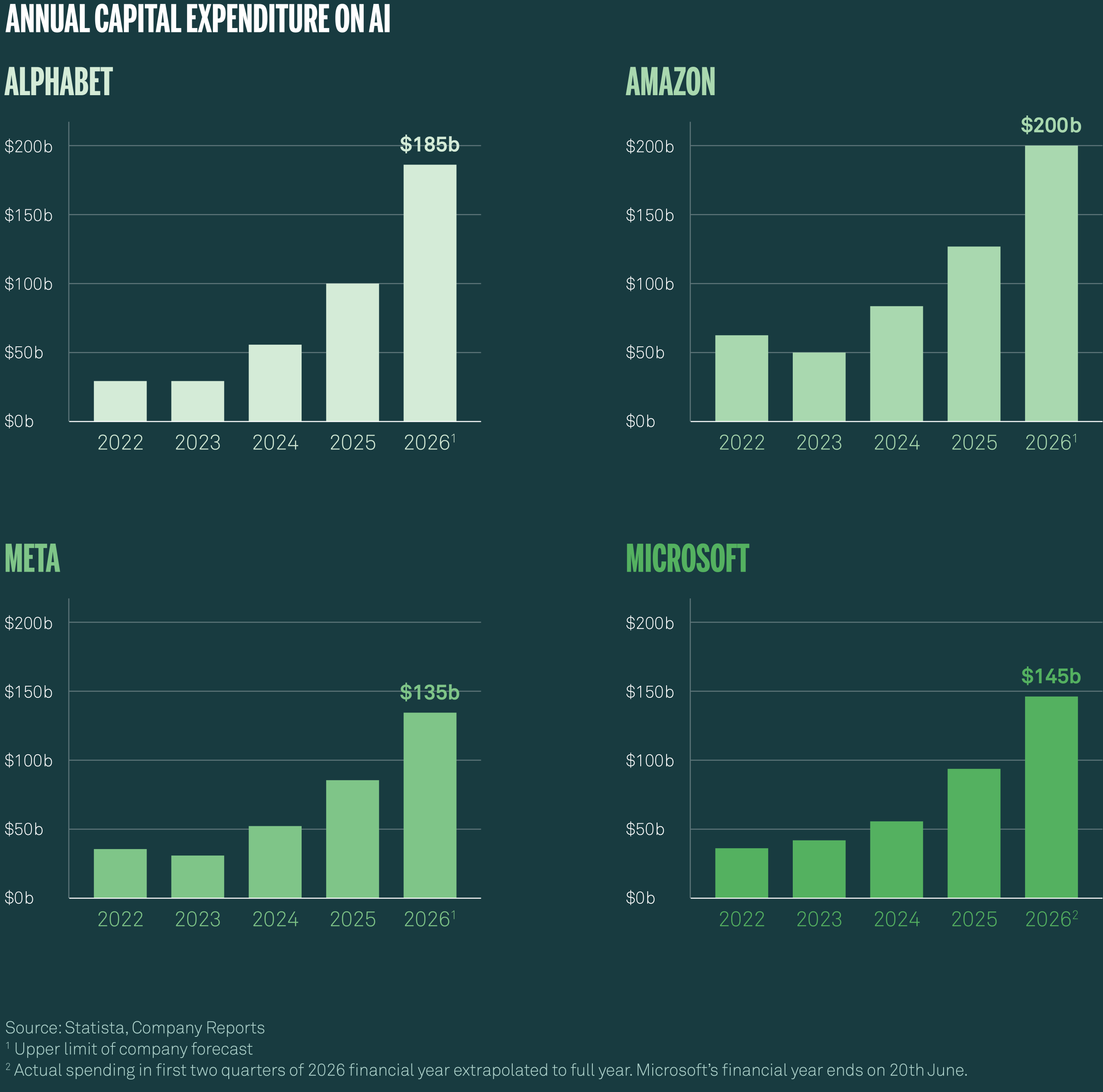
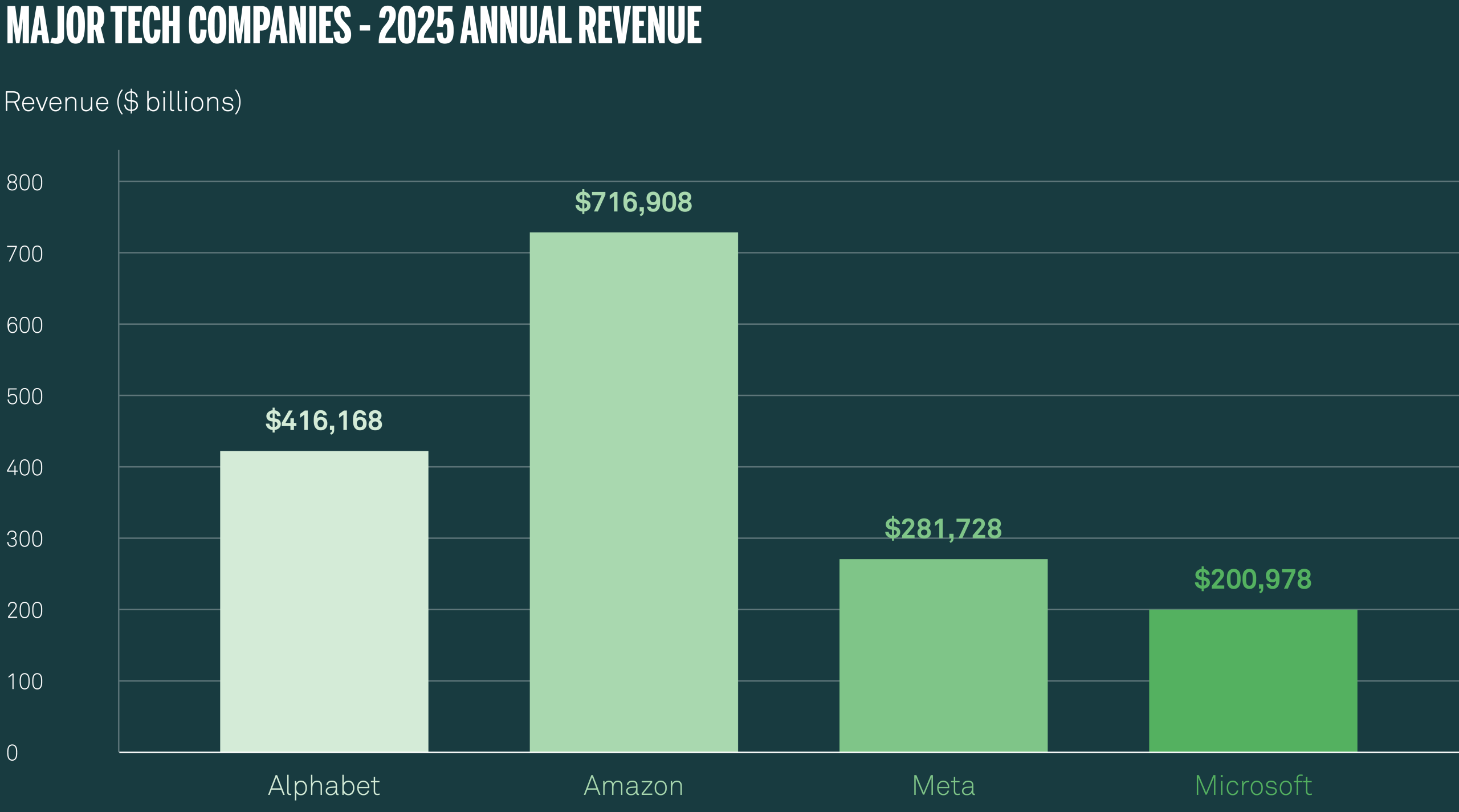
This type of chart (above) highlights the scale of AI-related capital expenditure by Microsoft, Alphabet, Amazon and Meta relative to their revenues (below). Even companies generating hundreds of billions in annual sales are committing a material portion of that revenue to AI infrastructure — data centres, chips and power capacity.
In simple terms, they are building what they believe is the next major technology platform — comparable to the internet or smartphone revolutions.
WHY SO MUCH URGENCY?
Because if one company develops the most capable AI platform — particularly in agentic systems that can automate real-world tasks — it could become deeply embedded across businesses and daily life. Winning early may create a powerful competitive advantage.
THE OPPORTUNITY — AND THE RISK
There is little doubt AI will improve productivity. It can analyse faster, draft faster and automate repetitive processes. Over time, this could lower costs and increase efficiency across many industries.
But building this infrastructure is extraordinarily expensive. If every major player spends aggressively at the same time, returns could be diluted. Profits may not rise as quickly as capital expenditure.
History offers perspective. Transformative technologies often deliver enormous societal benefits — but mixed returns for early investors. The late-1990s internet boom created enduring giants. It also created a bubble.
That does not mean AI is a bubble. It does mean valuations can move ahead of fundamentals when excitement builds.
THE INVESTOR’S CONUNDRUM
This is where many investors find themselves.
Few want to ignore what could be the most important technological shift of our generation. The companies leading AI development are already household names and significant index constituents.
At the same time, concentration risk is real. If too much capital flows into one theme, returns can disappoint — even if the underlying technology succeeds.
Markets are therefore balancing two rational fears:
- Missing out on a genuine structural transformation.
- Becoming overexposed if expectations prove too optimistic.
Both concerns can be valid at the same time.
MY TAKE
Getting my head around AI leads me to a measured conclusion.
AI is not a passing trend. It will change how businesses operate and how individuals work. The hyperscalers are investing at scale because they believe this is a massive generational shift, not a simple upgrade on what we already enjoy.
However, heavy investment does not automatically guarantee superior shareholder returns. The pace of spending is remarkable, and history reminds us that enthusiasm and over-valuation often travel together.
For investors, the sensible approach may not be to avoid AI — nor to chase it blindly — but to maintain balanced exposure within diversified portfolios.
AI could reshape the economy. It could also reshape valuations.
Navigating that tension — between opportunity and over-exuberance — is the challenge markets are currently wrestling with.
And, in truth, so are the rest of us.
Please contact NBL if you need to speak to us.