
WHY THE REDUCED ANNUAL EXEMPTION MATTERS FOR YOUR PORTFOLIO
For most of the past two decades, Capital Gains Tax (CGT) has been a relatively peripheral concern for the majority of investors. The annual exempt amount – the amount of gains you can realise each year free of tax – was generous enough that many clients could rebalance portfolios, fund ISA contributions, and take profits without a CGT liability arising at all.
That position has changed significantly. The annual exempt amount has been cut by over 75% in just three years, from £12,300 in 2022/23 to just £3,000 from 2024/25 onwards. This reduction has brought CGT firmly back into focus for investors of all sizes, and it carries practical consequences that we want to ensure you are aware of.
THE SCALE OF THE CHANGE
The table below illustrates how quickly the annual exempt amount has been reduced:
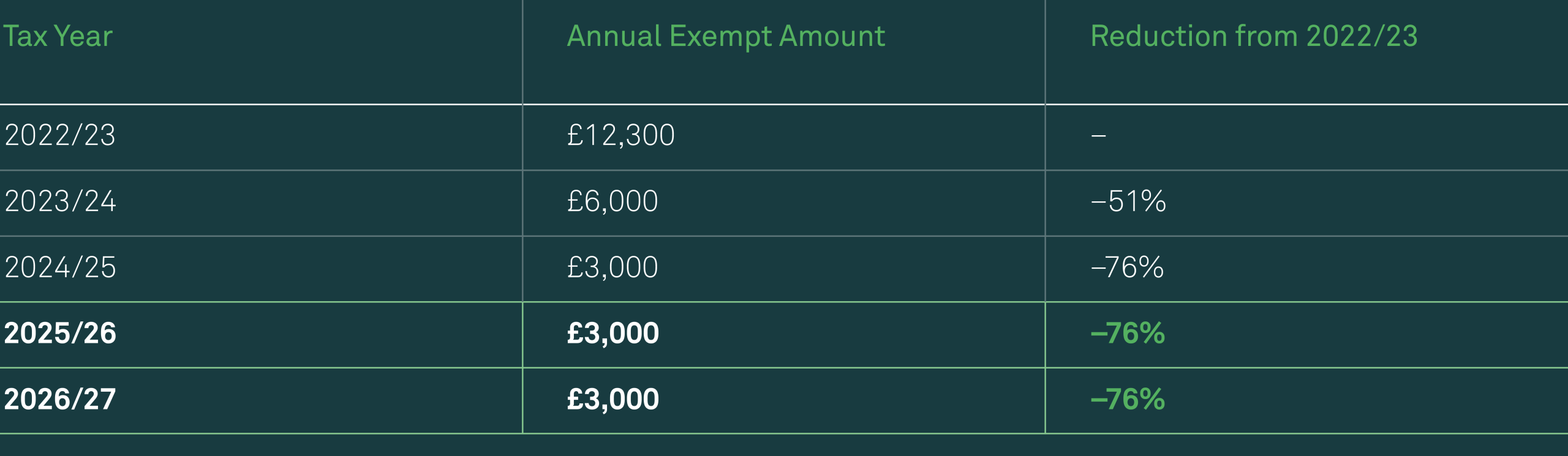
To put this in context: in 2022/23 a client could realise up to £12,300 in gains each year with no tax to pay and, crucially, no obligation to report those gains to HMRC. Today, that tax-free threshold is just £3,000. Any gains above this level will attract CGT at the following rates:

WHY THIS MATTERS FOR YOUR INVESTMENTS
For clients who hold investments in a General Investment Account (GIA), gains will have accumulated over time as markets have grown. When we sell holdings within your GIA – whether to rebalance, withdraw capital, or to fund your ISA – those gains are crystallised and become subject to CGT.
Previously, the generous annual exempt amount meant that for many clients these transactions could be managed entirely within the tax-free allowance. The reality today is very different. Even a modest portfolio disposing of holdings with reasonable growth is likely to generate gains that exceed the £3,000 threshold.
This also applies to gains arising outside your investment portfolio – for example, the sale of a second property, disposal of business assets, or the sale of other personal possessions above the relevant thresholds. All chargeable gains in a given tax year are aggregated, making it easier than ever to exceed the exemption.
THE ISA STRATEGY – SHORT-TERM COST, LONG-TERM BENEFIT
Our long-standing advice remains that funding your ISA allowance each year is one of the most effective steps you can take to build tax-efficient wealth. The ISA allowance stands at £20,000 per person for the current tax year (2026/27), and all growth, income, and gains within an ISA wrapper are entirely free from tax.
UPCOMING CHANGE – CASH ISA ALLOWANCE FROM APRIL 2027
The process we use is commonly known as ‘Bed and ISA’. We sell holdings from your GIA and use the proceeds to subscribe to your Stocks and Shares ISA, where the investments are then repurchased within the tax-free wrapper. Over time, this shelters future growth, dividends, and gains from any further tax.
The long-term benefits are clear. However, the short-term consequence is that selling from the GIA will crystallise any gains that have built up, and where those gains exceed your £3,000 annual exemption, CGT will be payable.
A PRACTICAL EXAMPLE
Suppose we sell £20,000 of investments from your GIA to fund your ISA, and the original cost of those holdings was £14,000. The gain is £6,000. After deducting the £3,000 annual exemption, £3,000 is taxable. For a basic rate taxpayer, the CGT due would be £540 (at 18%). For a higher rate taxpayer, it would be £720 (at 24%).
While no one welcomes a tax bill, this should be viewed in the context of the ongoing tax savings that the ISA wrapper will deliver year after year. Once inside the ISA, those investments grow completely free of CGT, income tax on dividends, and interest.
REPORTING OBLIGATIONS
This is the area that many clients find most unfamiliar and, understandably, least welcome. When your total gains in a tax year exceed the £3,000 annual exempt amount, you are required to report them to HMRC via a Self Assessment tax return, even if your only other income is taxed through PAYE.
For many of our clients, this is a new obligation. When the annual exempt amount stood at £12,300, most portfolio rebalancing and ISA funding could be completed without triggering a reporting requirement. At £3,000, that comfort zone has largely disappeared.
The key points to be aware of are:
- Self Assessment registration: If you are not already registered for Self Assessment with HMRC, you will need to register before you can file a return. This should be done promptly — there are deadlines for both registration and filing.
- Filing deadline: Self Assessment returns for a tax year ending 5 April must be filed online by the following 31 January. For example, gains arising in the 2026/27 tax year must be reported by 31 January 2028.
- Payment deadline: Any CGT liability is also due by 31 January following the end of the relevant tax year.
- Record-keeping: You should retain records of the original purchase cost, sale proceeds, and any allowable costs associated with the disposal of assets. We will provide you with a consolidated tax certificate detailing transactions within your portfolio.
We recognise that this reporting obligation is an unwelcome administrative burden, particularly for those who have never had to file a Self Assessment return before. To help manage this, we are able to recommend an accountant who can prepare and submit your return on your behalf. There will be a professional fee for this service, but it ensures your affairs are reported accurately and on time, and avoids the risk of penalties for late or incorrect filing.
STRATEGIES TO HELP MANAGE THE IMPACT
While the reduced annual exempt amount cannot be avoided, there are a number of steps that can help manage the CGT position:
- Use both spouses’ allowances: Transfers of assets between spouses and civil partners are treated as taking place at no gain and no loss for CGT purposes. Where applicable, transferring assets to a spouse before disposal can effectively double the available annual exemption to £6,000. This requires careful planning and should be discussed with your adviser.
- Phase disposals across tax years: Rather than funding the entire ISA allowance in a single transaction, it may be beneficial to spread disposals across two tax years – for example, selling in March and again in April – to utilise two years’ worth of annual exemptions.
- Offset losses: Any capital losses realised in the same tax year can be set against gains to reduce the taxable amount. Unused losses can also be carried forward to future years. This means that if you hold investments that are standing at a loss, there may be a case for realising those losses strategically.
- Pension contributions: While not directly related to CGT, maximising pension contributions can reduce your taxable income and may affect the rate at which CGT is charged, since the rate depends on your overall income tax position.
- Annual ISA discipline: The most effective long-term approach is to fund your ISA allowance consistently each year. The sooner capital is moved into the ISA wrapper, the sooner future growth is sheltered from tax entirely.
THE WIDER TAX CONTEXT
The reduction in the CGT annual exemption has not occurred in isolation. It sits alongside a number of other allowance reductions that have cumulatively increased the tax burden on savers and investors:
- Dividend allowance: Reduced from £2,000 in 2022/23 to just £500 currently, with dividend tax rates also increasing from April 2026. Dividends received outside an ISA or pension are increasingly likely to attract tax.
- Personal Savings Allowance: While unchanged at £1,000 for basic rate and £500 for higher rate taxpayers, the frozen income tax thresholds mean more individuals are being pushed into the higher rate band, reducing their savings allowance.
- Frozen income tax thresholds: The personal allowance (£12,570) and higher rate threshold (£50,270) remain frozen until at least 2028, meaning wage growth continues to push more income into higher tax brackets – a process often referred to as ‘fiscal drag’.
Taken together, these changes reinforce the importance of using all available tax-efficient wrappers – ISAs and pensions in particular – as the core of your investment strategy.
WHAT TO EXPECT FROM US
As your adviser, we will:
- Continue to recommend funding your ISA allowances where your circumstances permit, and manage the investment transition in a tax-aware manner.
- Provide you with the information you need to report any gains, including a consolidated tax certificate summarising the relevant transactions.
- Where helpful, recommend a trusted accountant who can assist with your Self Assessment return and advise you on the associated costs.
- Discuss strategies such as phasing disposals, spousal transfers, and loss harvesting to minimise the CGT impact within the rules.
- Keep you informed of any further changes to CGT rates, allowances, or reporting requirements as they arise.
IN SUMMARY
Important Information
This document is for information purposes only and does not constitute personal financial advice. Tax treatment depends on individual circumstances and may be subject to change in the future. The value of investments can fall as well as rise, and you may get back less than you invest. Past performance is not a reliable indicator of future results. If you are unsure about any aspect of your tax position, you should seek independent professional advice.
Tax rates and allowances stated are based on current legislation and HMRC practice as at May 2026 and are subject to change.
Please contact NBL if you need to speak to us.