
History argues that geo-political shocks tend to be short-lived in terms of risk assets being sold off, especially if global oil supplies are not vulnerable. The key exception is the 1973 Oil Shock, which was prolonged and caused assets to struggle for an extended period.
The flashpoint in the renewed Iran-Israel hostilities are the Strait of Hormuz. This represents an important chokepoint in global energy supply from the Middle East. That said, closing the Strait to shipping would impact Iran as well, hence we do not see this as a baseline scenario.
Our baseline scenario is for a de-escalation once Iran’s nuclear weapons capabilities are severely diminished. President Trump is under considerable domestic pressure to see oil prices come down substantially – that would require a cessation of attacks in the Middle East.
BACKGROUND
On 13 June 2025, Israel launched a pre-emptive military strike on Iran, codenamed ‘Operation Rising Lion’. This targeted nuclear facilities including enrichment plants, uranium mines, power plants as well as research facilities, nuclear scientists and senior Islamic Revolutionary Guard Corps (IRGC) commanders. The strikes appear to have caused significant setbacks to Iran’s nuclear program, although the nuclear facilities are suspected to be deep underground and largely unreachable without the US’s bunker busting bombs. It is therefore difficult to determine the true success of the strikes. Following retaliatory strikes from Iran, the two sides have since been conducting ongoing missile exchanges, with several waves of missile attacks now being fired from both sides.
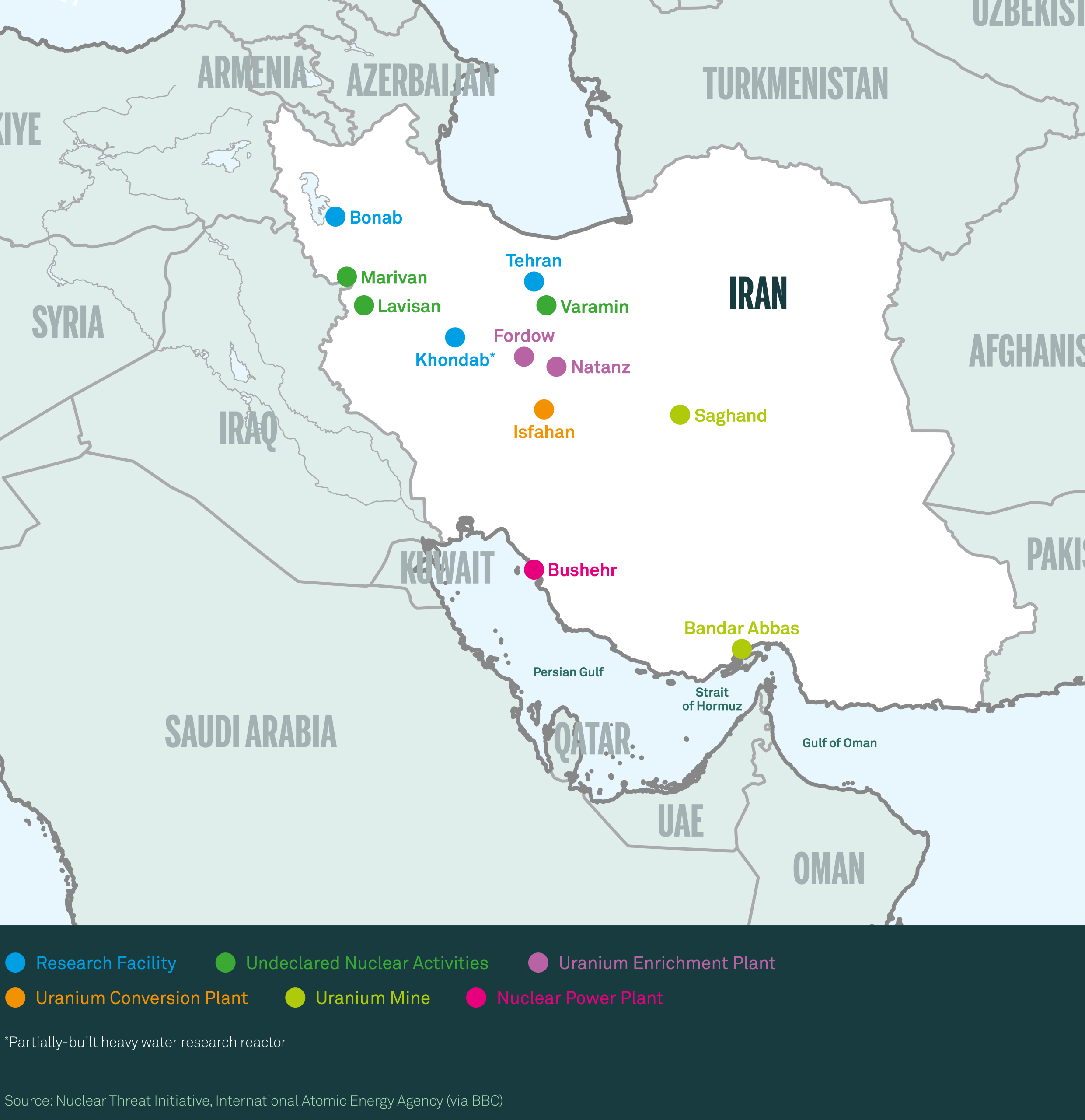
Israel’s reasoning for these latest strikes centred on preventing Iran from achieving nuclear weapon capability, which Israel claimed was only days away. Israel’s Prime Minister, Benjamin Netanyahu framed the operation as essential to “roll back the Iranian threat to Israel’s very survival”. While Israel denies aiming to topple Iran’s regime, reports emerged that Trump had vetoed Israeli plans to kill the Supreme Leader, Ali Khamenei. The latest strikes on natural gas and oil infrastructure in Southern Iran are also indicative of an objective to cripple domestic infrastructure, which again would point towards trying to topple Khamenei and the current regime.
POTENTIAL FOR FURTHER ESCALATION
Both Iran and Israel have a limited supply of long-range missiles to attack each other with, which means that the current exchange is expected to last roughly two weeks at the current rate of ballistic missile usage. However, a lot can happen in two weeks, and there is always the possibility that other nations will be dragged into the conflict, altering the state of play dramatically.
Any increased US involvement would likely prompt a more severe reaction from Iran. The Iranian regime issued a stern warning to the UK, US and France to not assist in intercepting any missiles, or Iran would target their military assets in the region. This ship has already sailed, as the UK has intercepted Israel bound missiles, and the US has almost certainly supplied intelligence for Israel’s use. More obviously, much of the equipment used by Israel is supplied by the US (as boasted by Trump on Truth Social) which directly involves them by association. However, the fact that Iran has not retaliated against the US in any way is encouraging, and points to them being less aggressive than in January 2020 when they retaliated against the assassination of the IRGC head Qasem Soleimani by targeting US bases in Iraq.
The question now remains whether Iran will target US and European assets in the area, or even close the Strait of Hormuz, significantly limiting the global supply of oil and almost certainly creating an oil price shock far greater than that seen already. The Strait of Hormuz is a significant choke point for global energy supply, supplying 20% of the world’s daily energy (crude and LNG) needs. Any closure of this Strait would cause energy prices to rise dramatically, but this would be equally (if not more) punitive for Iran and hence looks unlikely.
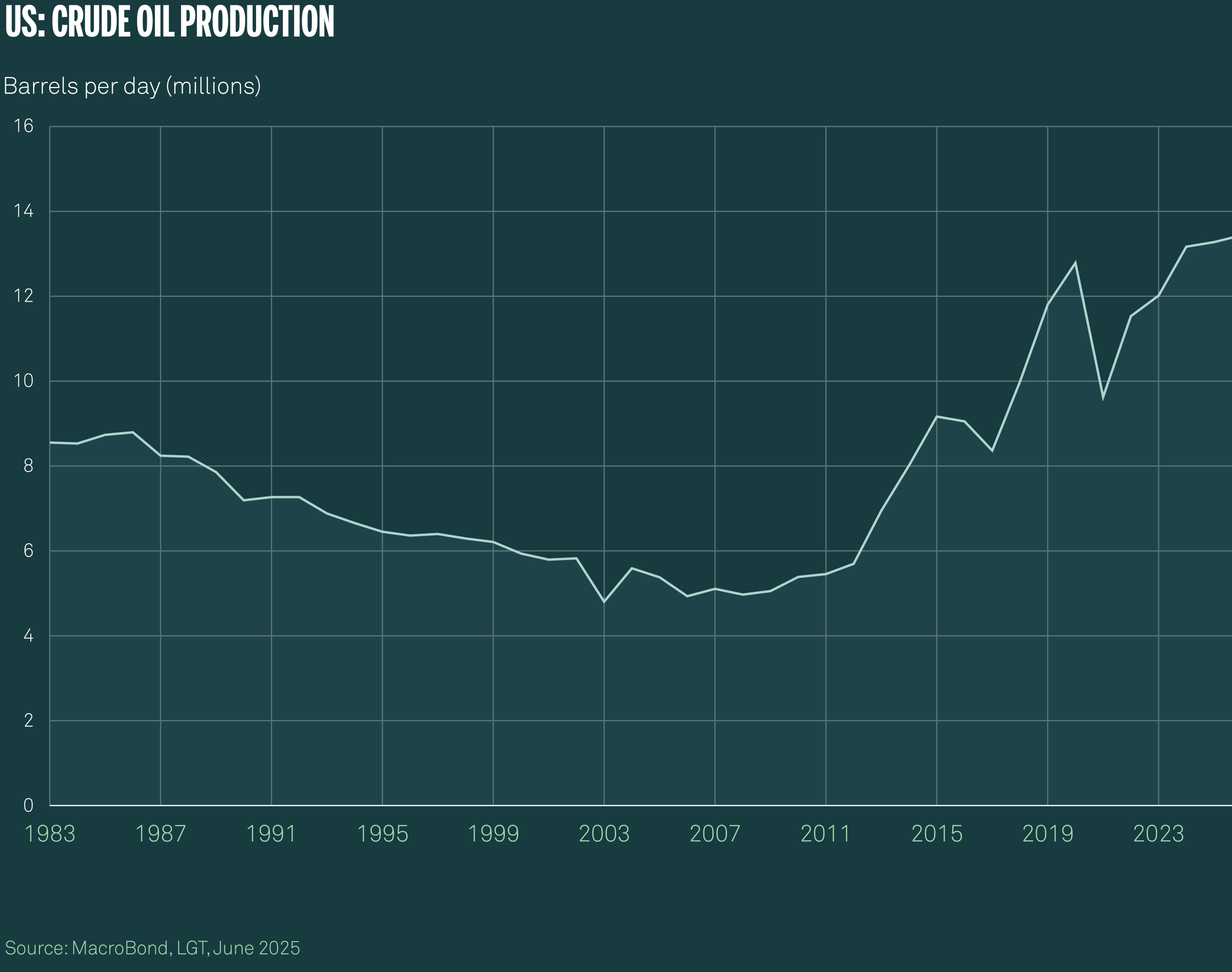
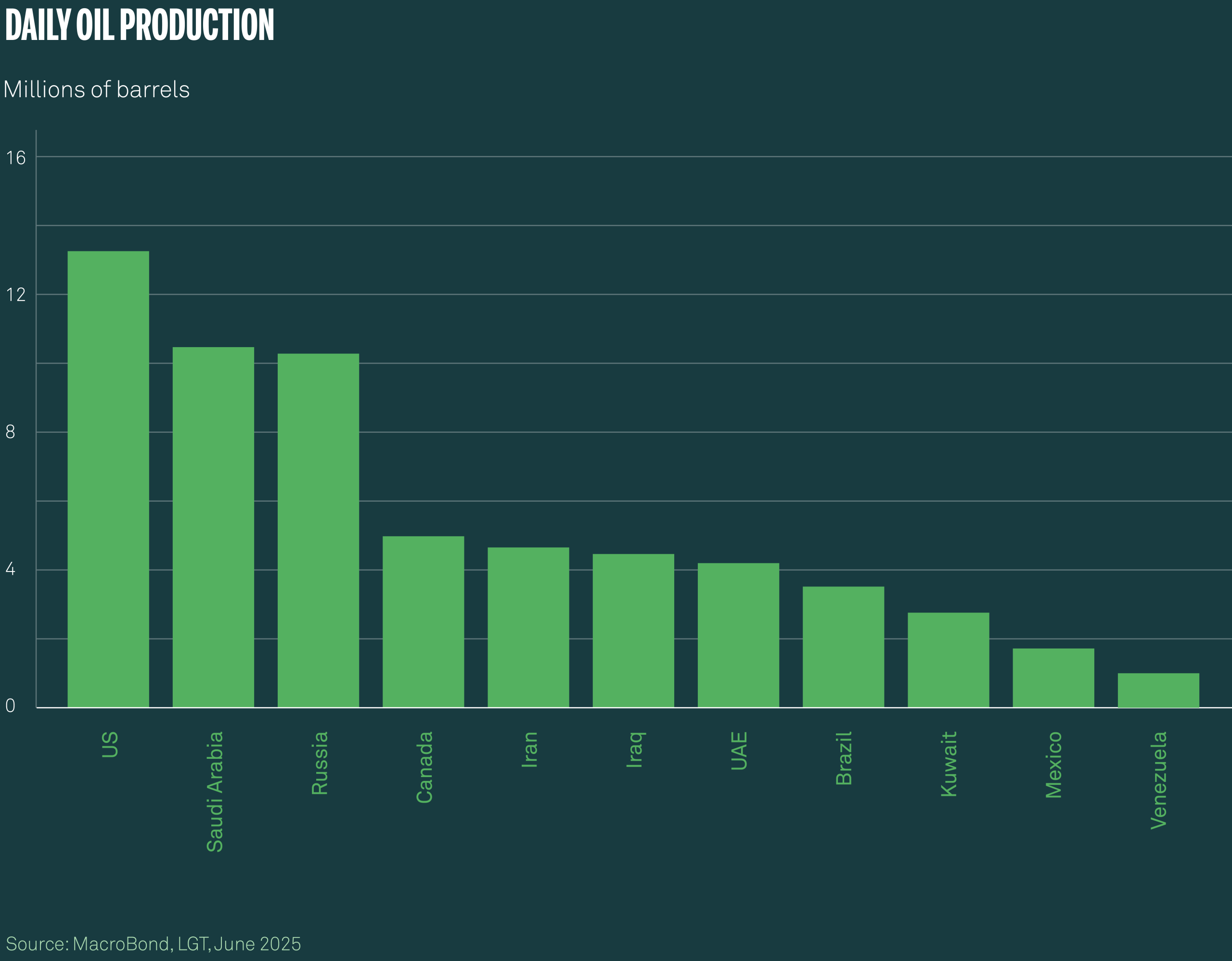
US IS THE WORLDS LARGEST OIL PRODUCER
If prices go up and there is no corresponding increase in wages there cannot be any ‘consumer inflation’ in fact it is much more likely deflation or economic contraction. We all have a certain amount of money to spend, for the vast majority of people this is finite and there is little flexibility to change that. If prices rise, most people have to cut what they spend in at least one area. The impact of this is to slow the economy as liquidity is reduced or diverted. The economy hinges on the free flow of money, oversupply can cause it to overheat and over-restriction – well the opposite!
PORTFOLIO IMPLICATIONS
The conflict has triggered a modest rise in oil prices so far, with WTI and Brent Crude moving up roughly 10% since the initial breakout. Analysts predict that continued escalations could see oil prices move from $70 to a new range of $75-$130, with the closure of the Strait of Hormuz consistent with the upper end of this range. Higher oil prices have the potential to increase input costs for businesses and ultimately depress global growth, should a severe price shock persist for some time. Encouragingly however, equity markets have become relatively desensitised to Israel-Iran conflicts following a turbulent year, viewing such events as buying opportunities. Equity markets are therefore relatively unmoved as a result, with small falls on Friday 13th June due to the sharp oil price reaction, only to recover by close of Monday 16th June.
As with other geopolitical events, at present we do not see any long-term investment implications from the latest Iran-Israel conflict. Our portfolios have limited Middle Eastern equity exposure and include downside protecting assets such as fixed income and alternatives which have held up well, as expected. Our baseline case is for a gradual de-escalation once Iran’s nuclear capabilities have been severely diminished. Whilst these events do add to volatility, history tells us this is typically very short lived. One notable exception is the 1973 Oil Shock, although global oil supplies are far less vulnerable today. Investors should stick to their plans and remain invested.
PORTFOLIO STRATEGY IN A NUTSHELL
- Given the current contrast between healthy fundamentals and global policy uncertainty which is now compounded by the Israel-Iran conflict, we have maintained our equity positioning across portfolios with a neutral position on equities. That said, we continue to monitor developments and are comfortable in the knowledge that the companies that we own are high quality and durable and should be relatively immune over any reasonable time period to any flare up in the Middle East.
- Given the gradual process of de-dollarisation we are witnessing, we are monitoring FX risk closely and staying open to hedging strategies within the portfolios. This may look like using currency hedged share classes within the portfolio construction or a slight rotation out of US assets in favour of global equity.
- In Fixed Income, we have maintained preference for positioning into short to mid duration investments, given that extending duration does not compensate for the current risks on yields due to a growing US Budget deficit and now potential pressure on headline inflation should energy supply channels be disrupted.
- In Alternatives, we maintain exposure to gold through funds such as Troy Trojan, CG Absolute Return and Cohen & Steers Diversified Real Assets. These contribute as strong portfolio diversifiers following the recent geopolitical escalation.
Please contact NBL if you need to speak to us at any time.